Showing posts with label advocacy. Show all posts

Wednesday, March 14, 2018

Dispatch from Germany


I grew up in small-town Germany. Welzheim, my home town, is a city of 10,000 people. It's on the edges of the Stuttgart metro region (population 2.7 million), about 30 miles from Stuttgart itself. My parents still live in Welzheim, and I visited them for a week this March. And, of course, I rode my bike.

Lovely small roads make for great biking
So as Welzheim is in Europe, there obviously is a lot of bike infrastructure, right? And nobody drives a car. Well, note quite. Germany with good reason is known as a nation of cars (Mercedes Benz and Porsche have their headquarters in Stuttgart). And in a small, rural town like Welzheim, there's actually not much obvious bike infrastructure to speak of. There are zero protected bike lanes, bike parking is pretty mediocre, and even on-street bike lanes don't exist, with the exception of an advisory bike lane on two streets. And yet, the biking experience is much better than you'd expect.

Traffic calming is one big reason for this. On most residential streets, the speed limit is 30 kph (19 mph). More importantly, the streets are built so that people by and large actually drive at that speed. The streets by default are much narrower than a typical US residential street. So when a car is parked on the street, two cars generally can't pass each other, keeping speeds down. Further, intersections are usually unsigned, meaning that the person coming from the right has the right of way. Effectively that means that at each intersection you have to be prepared to stop. Actual stop signs, on the other hand, are so rare that my navigation app actually gave me a voice notification the few times that I did encounter one.

Mail carrier on electric-assist cargo trike
Traffic signals are also much rarer than in the US. The whole town of Welzheim has not one signal. Roundabouts, on the other hand, are plentiful. Starting in the 1980s, new intersections on busier streets often were built as roundabouts, or old ones were retrofitted. On the 8-mile drive from the nearest train station to my parents' house, you will encounter no fewer than 10 roundabouts. Now in the US, among bike advocates and the general population, roundabouts have a bad rap. Much could be said here, but it's important to note that German roundabouts are built smaller than US ones, and multi-lane roundabouts like the one we have on Mineral Point Road in Madison are very, very rare. More narrow lanes means people driving have to slow down more and aren't tempted to pass people on bikes on the roundabout approaches or in the roundabout.

Some residential streets are designates as "traffic-calmed area," a concept similar to the Dutch woonerf. Cars must drive at walking speed, and people walking and biking are entitled to the whole street. Again, those streets are usually built in a way that makes it clear that people must drive slowly.
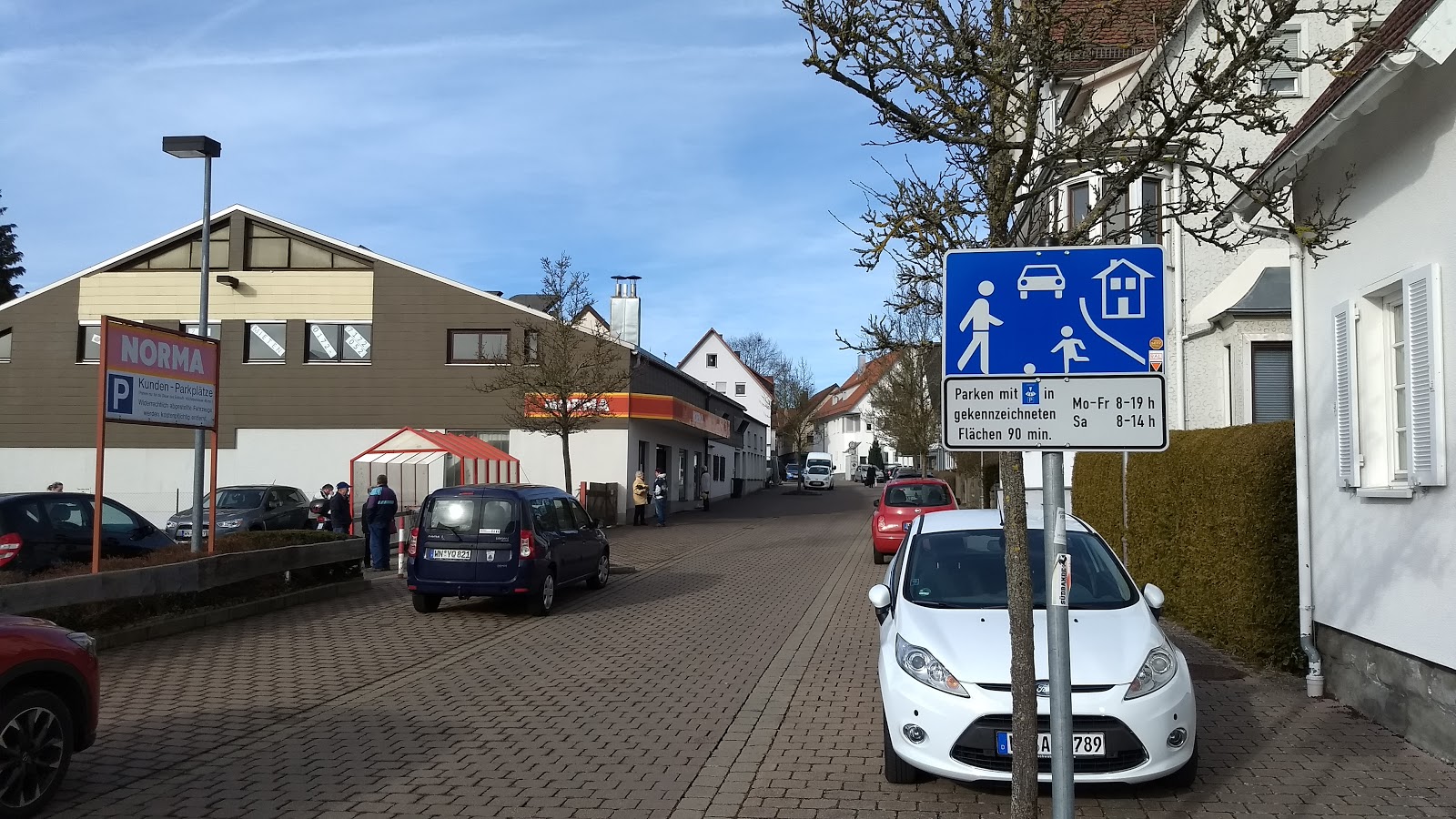


What about commercial streets? Welzheim's main street looks like this:


The speed limit is 20 kph (12 mph), and as a pedestrian you can easily cross the street wherever you like. Through strategic placement of planters or on-street parking spots, there will be locations where two cars can't pass each other, keeping speeds down.


Going one step further, some cities have pedestrian malls in their city centers. This is Schorndorf:


Biking is sometimes restricted in these areas, either banning bikes at specific times or asking people to bike at walking speed. Deliveries by car or truck are permitted only during a short time window each day.

Bike parking is not that great by Madison standards. If there are bike racks at all, they often default to what Germans call the Felgenbieger (rim bender) style of rack. This is probably one reason that kickstands are very common on bikes, allowing people to just park their bike wherever when they go for a quick trip to a shop.

E-assist bike on a rim bender rack
Note the wheel lock on the bike on the right. Good enough for a quick stop.

At train stations and in larger cities, bike parking facilities tend to be better. For instance, at the Bad Cannstatt train station, there is a "bike station" where you can valet your bike (and also have it repaired while its parked there). With the Judge Doyle Square bike center, Madison is poised to get similar facilities. We'll have to see how well they work without a transit location.

The bike station is run by a charitable enterprise, training and employing people with disabilities or other challenges


Once you get out of town, biking can be really awesome. One feature of the region is a dense network of farm or forestry service roads and tracks. For historical reasons, parcel sizes in this part of Germany are very small. This is an aerial image of Welzheim and its surroundings (Image: Google Maps).


All those little strips of fields that you can see are owned by different farmers (and the same is true for forest parcels). And of course that means that each farmer has to be able to get to his or her field. The service roads to get them are public right-of-way, but motor vehicle access is limited to farm traffic. 
Farm road

Forest service roads are usually unpaved
Navigation on these roads and tracks used to be a challenge. There is no orderly grid system, and it could often be hard to tell where any given road would take you. Fortunately, over the past decade or so, communities have made much progress on signing bike routes that string together little pieces of road to connect villages and cities.
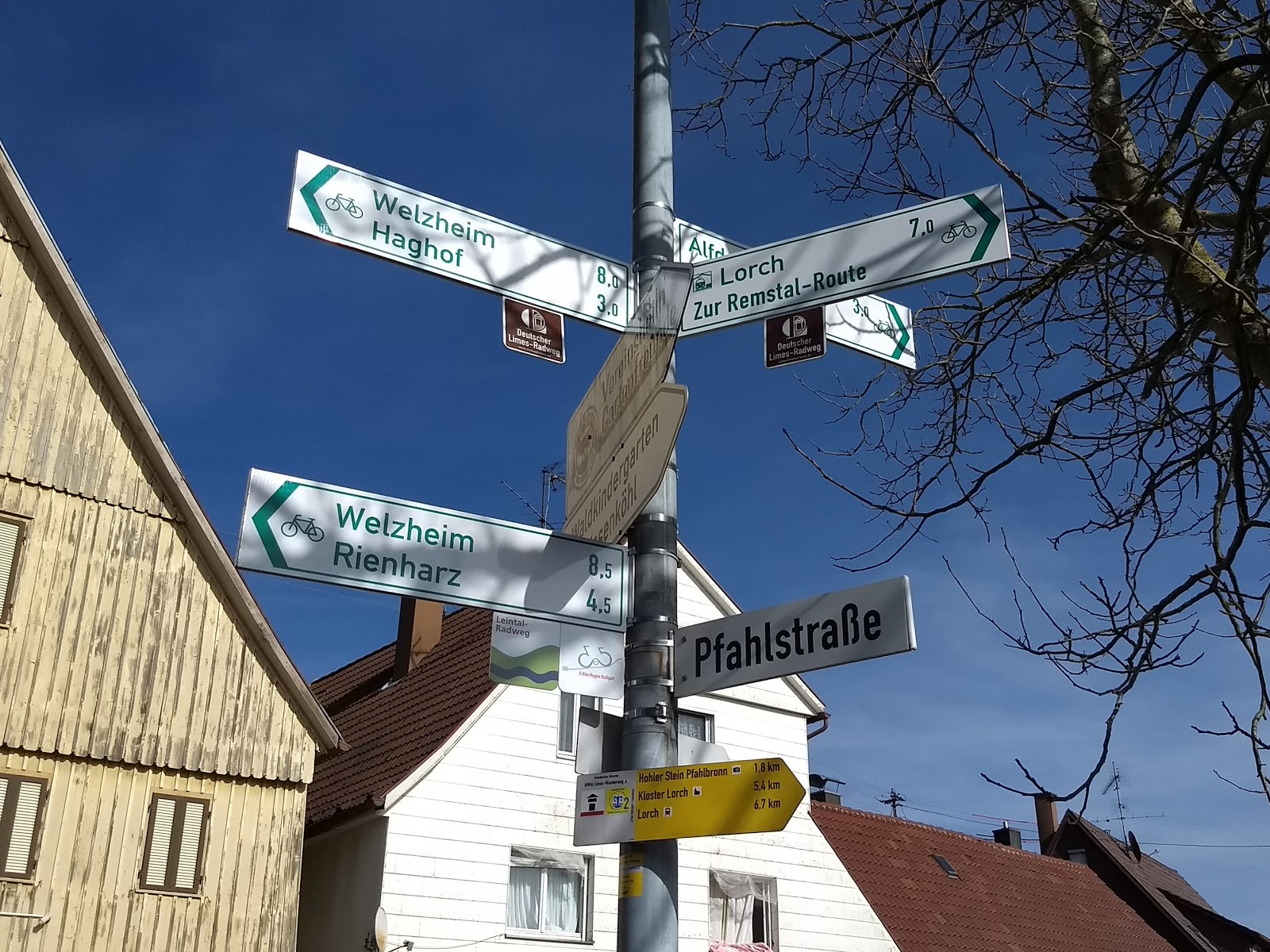
The green signs point show bike bike route destinations and distances; the small square signs underneath them are for touristic bike routes; the yellow sign is for hiking.

I want to be clear that there are some problems with these routes: Welzheim is in a rather hilly area, and the easiest routes up those hills are often taken up by roads. So if you follow a bike route, you should always be prepared for steep climbs. The routes also do not get cleared of snow in the winter. And finally, sometimes the routes are geared more toward recreational biking instead of providing the most direct route. But overall, they provide an amazing low-stress network for people biking, for recreation and transportation alike.

Some snow left on this forest road


Are there any takeaways for bike advocacy in Madison? Obviously some of the things I have described we can't recreate here. The issue of traffic calming may offer some lessons, though. Many advocacy efforts here in the US focus on creating protected bike lanes as a way to enable people of all ages and abilities to bike. And there are good reasons for that. But at the same time we shouldn't lose track of the fact that traffic calming can also create spaces that are great for biking and walking (and have other benefits such as reduced noise). This applies not only to residential streets, but also to commercial corridors. This does require being serious about it, though. Merely slapping a 20 mph speed limit sign on an otherwise unchanged street is not going to be enough. And neither is the occasional speed bump or sporadic enforcement. Diverters that prevent cut-through traffic, reducing the width of a street, creating bump-outs at intersections--these are some measures that may transform a street into one that many people will feel comfortable biking on.

A second takeaway is that good signage can add a lot of value at little cost (financial and political. In a way, the farm roads in Welzheim are similar to, say, the network of multi-use paths in Fitchburg.

Fitchburg path network (Map: OpenStreetMap contributors)

You can get to many destinations on those paths. But unless you're really familiar with the area, navigation is a challenge. Similarly, if you're riding on the Southwest Path or Cap City Trail, knowing where to turn off to get to a destination on Monroe or Willy Street is not obvious. Good signage would help with this. Dane County actually developed a "Bicycle Wayfinding Manual" (warning: big pdf) to address this issue, but implementation has been slow so far.

Thursday, January 21, 2016

Madison Winter Biking Survey

Bike racks in front of the Wisconsin Institute for Medical Research

If you live in Madison (Wisc.) and bike in the winter (or would like to but are deterred by something), please take the time to fill out the annual winter biking survey. The survey is run by Grant, a local bike advocate and member of several winter-bike-related city commissions. Having better data on where the problems of winter biking lie—and what works well!—will help improving the conditions for getting around by bike at this time of year.

Link to the survey

Friday, September 18, 2015

Bike commuting 2014 in Madison: More stagnation

It's that time of the year again when the US Census releases the numbers of last year's American Community Survey (ACS), For bike advocates this is always an exciting event, as the ACS, despite its limitations, is one of the few available data sources about biking that allows us to look at long-term trends in cycling in the US.


As soon as I heard the data was out, I plugged the latest numbers into the spreadsheet I created for a post last year. It quickly became clear that the main news conveyed by those numbers is that there isn't really any news: Continuing the trend since approximately 2009, the percentage of people cycling to work in Madison has stagnated at around 5%. Compared to the US average and many other metro regions in the US, this percentage is high. Compared to the mode share in many European cities, though, there is a lot of room for improvement. Stagnation is not enough.

Seattle Bike Blog has some numbers for comparison:
Seattle (3.7 percent) is now in a bike commute race against Minneapolis (4.6) in the Mid-West, DC (3.9) on the East Coast, New Orleans (3.4) in the South, San Francisco (4.4) and Oakland (3.7) on the West Coast, and Tucson (3.5) in the Southwest.
And then of course is Portland, which despite all lamentations actually has increased its bike mode share to above seven percent for the first time.


As for explanations, my previous post and the comments are probably still accurate. Getting to somewhere around five percent, especially in a college town, is relatively easy. Beyond that, real investment in infrastructure and incentives/disincentives needs to happen. In Madison this has not happened. Changes that might entice people to bike to work have changed only incrementally. An improved intersection here, a widened bike lane there. But probably most Madisonians would agree that by and large there haven't been any major efforts that would make cycling a more appealing transportation option. No protected bike lanes, no rebuild of horrible intersections such as the one at Machinery Row, and many main streets in town remain without any bike infrastructure. Similarly, driving and parking continue to be cheap and convenient. At my workplace, for instance, construction has just begun on a massive expansion of a parking ramp, and in the hotly debated downtown redevelopment project of Judge Doyle Square, free or heavily subsidized parking seems to be a mostly unquestioned component of the plan.

Update 9/19: Here's a chart of all modes for 2006-14:
Commute share 2006–2014. Data: American Community Survey

Thursday, February 5, 2015

Save Wisconsin's bike funding and Complete Streets!

From the Wisconsin Bike Fed blog:

The governor’s budget (Senate Bill 21) would:
  • Repeal Wisconsin’s successful Complete Streets law. The law requires that bicyclists and pedestrians be taken into account whenever a road is built or reconstructed with state or federal funds. There are all manner of ways to get an exception if the project would be too expensive or if use by bikes and pedestrians is projected to be too light. The law works well in practice. Yet, the governor chose to eliminate it altogether. This would mean many fewer safe places to bike.
  • Cut the Transportation Alternatives Program by $2 million. The governor would eliminate all state support for this program, leaving only federal dollars. TAP is used for a variety of pro-biking initiatives, including bike plans and facilities.
  • Essentially eliminate the Stewardship Fund. The Knowles-Nelson Stewardship Fund (named for iconic Republican Governor Warren Knowles and Democratic Governor and Senator Gaylord Nelson) works to purchase and protect land for future generations. Funds for state trail purchases are included in the program. The governor would stop all purchases for over a decade.
 If this proposed budget were implemented, it would be a terrible step backwards for cycling and walking in Wisconsin. Complete Streets has been a successful instrument to provide amenities and allow access for all street users, not just people driving. Repealing this requirement is shortsighted and will make Wisconsin a less livable state. Streets only get rebuilt every 20 to 40 years, and therefore even if Complete Streets requirements were to be introduced some time in the future, the damage already would have been done. So please take some time and write to your state legislator or the governor to make your voice heard.

Wednesday, October 15, 2014

I Bike, I Vote: 2014 Wisconsin Bike Summit

Last Friday I attended the 2014 edition of the annual Wisconsin Bike Summit in Madison. Having just recently relocated to Madison, I figured the summit would be a great opportunity to connect with the local and state-wide bike advocacy scene. The schedule of the summit was packed, with three concurrent tracks. First, however, were the opening remarks by Michael Johnson. Johnson is the highly charismatic CEO of the Dane County Boys & Girls Club—and also an avid cyclist who goes on weekly group rides at 4:30 in the morning!

Dave Cieslewicz in a great outfit: Suit, bike tie, Sidis

The first panel I attended was on increasing the share of women amongst cyclists. The fact that women on average bike less than men (and the larger issue of equity; see below) has received quite a bit of attention lately, and the Bike Fed started a program for Women & Bikes. The panel was introduced by Carolyn Dvorak, the ambassador for the La Crosse group. Krista Crum from the Madison bike share system B-cycle presented data on how bike share in general and the system in Madison in particular can be a tool for increasing the proportion of women cycling. Whereas the overall share amongst cyclists in the US is somewhere between 20 and 30 percent, the Madison B-cycle system is much closer to gender parity. Cassandra Habel, the Madison ambassador of Women & Bikes and the person behind Spokehaven, then presented the wide range of activities that she has started in Madison to offer a variety of ways for women to engage with cycling at any skill level—fix-a-flat clinics, no-drop group rides, support for women racers, ...

The future of car travel

“A Vision for Wisconsin’s Transportation System” was the title of the second panel I attended, and it probably had the least bike-focus. Ashwat Narayanan from the advocacy group 1000 Friends of Wisconsin and Bruce Speight from the Wisconsin Public Interest Research Group presented their research into the misguided transportation policies in Wisconsin: a stagnating or declining number of miles driven in cars is met with costly highway capacity expansions that cost billions. As a regular Streetsblog reader I was quite familiar with their work and would have appreciated it if the speakers had explicitly the role of cycling in the big picture. But maybe that is the conclusion: Highway building is such a behemoth that active transportation investments simply pale in significance.

After a lunch break speech by RT Rybak, the former mayor of Minneapolis, I went to a panel that presented a number of statistics about bike commuting and potential strategies to increase them. I love this kind of research, and the work by Robert Schneider, professor of urban planning at UW–Milwaukee, was very interesting: He analyzed the 100 census tracts with the highest share of bike commuters and tried to distill what distinguished those neighborhoods from ones with lower bike commute shares. While some factors aren't easily changed, for example the proportion of university students that characterizes cities like Davis, CA, I think this kind of work has enormous promise for informing future policy and advocacy.

Image credit: Adventure Cycling Association

Another panel that promised to be very interesting was about the US Bicycle Route (USBR) System and its implementation in Wisconsin. The USBRs are an effort to create a US-wide network of long-distance bike routes. As a volunteer mapper for OpenStreetMap (OSM) I had earlier agreed to help getting the planned Wisconsin routes into the OSM database, but never heard back from the people in charge. At the panel a representative of WisDOT and the Department of Natural Resources presented the three corridors planned for Wisconsin, two going east–west and one going north–south. Somewhat confusingly, there is also a fourth route in the plan, USBR 30 through Madison, but that one is planned not by state agencies but by the Bike Fed and was not mentioned at all during the panel. The second presentation was by the president of Rails-to-Trails.  Their work to convert abandoned rail corridors around the country into trails for active transportation is quite impressive. I was also intrigued by the fact that they have a detailed, volunteer-created database of both rail corridors and trails, including surface information. This seems like a great opportunity for collaboration with OpenStreetMap.

The final panel of the day returned to the topic touched upon in the first panel: Equity. The Milwaukee coordinator of the SmartTrips program, Shea Schachameyer, presented her efforts on data collection about biking and walking in a low-income neighborhood. How many people of color or people with low income already bike? What do they consider to be barriers to biking and walking more? And how can those barriers be overcome? Keith Holt of the Bike Fed addressed the question of equity more generally. How can equity be defined in the world of bike advocacy? How can the momentum around the topic that recently popped up around the topic be translated into effective action? As one can imagine, there are way more questions than answer. One example of equity work done right that Holt presented was the creation of the Underground Railroad bike route. Despite Holt's initial skepticism about the very-white-and-from-Missoula bike touring organization Adventure Cycling Association, he described how the cooperation with the University Pittsburgh's Center of Minority Health ultimately led to a successful project beyond appropriation of Black history.

Eleanor McMahon in front of the Capitol

The summit concluded with a group ride to the State Capitol where Eleanor McMahon, a member of the Canadian legislature and founder of the Share the Road Ontario gave a short speech.

I really enjoyed the summit. The only slight criticism I have is that, as it not uncommon with these types of events, the schedule was so packed that discussion and socializing often came up short. Probably a lot of that happened at the Saris Gala that happened in the evening and that I unfortunately couldn't attend. It also would have been helpful if the name tags had stated the organization or location of the participants. Especially for newcomers to the Wisconsin bike advocacy scene this made it hard to figure out who was who.


Thursday, September 25, 2014

15 Bike-friendly Businesses In and Around Madison

Please excuse the horrible headline—I can assure you that Ride or Pie?! has not been acquired by Buzzfeed. But this post actually is about the fifteen businesses and organizations that have been awarded the bike-friendly designation by the League of American Bicyclists (LAB).

Each year the League awards one of four levels of recognition to companies and organizations that are especially bike-friendly for their employees. The awards are based on an 14-page questionnaire covering the four E's: encouragement, engineering, education, and evaluation and planning. In contrast to some other bike-related awards or rankings based on dubious data, this process makes the bike-friendly business designation a meaningful measure. Potential employees can use the awards as one factor in deciding where they want to work. For companies and their current employees, on the other hand, the survey provides a tool for evaluating and improving bike-friendliness.

This year's new awards were announced yesterday, and there are now over 800 bike-friendly businesses (BFBs) in the US. Wisconsin currently ranks fifth among the states, with 43 BFB's, and a sizable number of those businesses are in and around Madison.

Here is a map of all of the ones in Madison. The size of the bubble represents the number of employees, ranging from 5 to 23,000; and the color represents the level of bike-friendliness: bronze, silver, or gold. We currently don't have a platinum level BFB, but maybe that will change in the 2015 edition of the competition.


Tuesday, September 23, 2014

Have we reached a plateau? Latest figures on bike commuting in Madison, Dane County, and Wisconsin

There is much anticipation in the bike advocacy world around the annual release of the American Community Survey (ACS) by the US Census Bureau. Among a wealth of other data on the US and its population, the ACS also asks by which means of transportation people get to work. I decided to look at the data for my home town, county, and state—Madison, Dane County, Wisconsin.

There are a multiple caveats on the data quality, but since there aren't many alternatives available, the ACS is still a valuable source of information of bicycle use and transportation trends. Some of the limitations become clear when we look at the actual question asked:
How did this person usually get to work LAST WEEK? If this person usually used more than one method of of transportation during the trip, mark (X) the box of the one used for most of the distance.
So someone who bikes to work on two days and takes her car on three would count as a car commuter. Similarly, a person who rides 5 miles to the commuter rail station, takes the train downtown, and then walks to their office, would count as a train commuter. The other, less obvious limitation, which is especially relevant for Madison, is that students' trip to their university are not considered commutes and therefore not counted. And of course, trips to work constitute only part of all trips made.

That said, let's look at the data, beginning at the state level.
Maybe unsurprisingly, at the state level the picture for bike commuting appears rather bleak. Between 2006 and 2013 the rate of bike commuters has been basically flat and far below one percent. However, one must keep in mind that there are only six states in the whole of the United States that have a mode share of one percent or more, and the national average is 0.62%. Nonetheless, the flat trend raises some uncomfortable questions for bike advocates.

 How do things look in Dane County? The proportion of people riding their bike to work is significantly higher than at the state level, and over the seven-year period there also is a small but noticeable increase in bike commuting.
This pattern repeats itself at a higher level in Madison. Given that Madison respondents make up roughly half of those of Dane County, this comes as no surprise. As you can see with the dotted lines in the charts, at the county and city level the margins of error are quite sizable, and conclusions about trends should be taken with a grain of salt. But when we compare the Dane and Madison data with cities with a similarly high rate of bike commuting, it appears that the growth in bike commuting may have plateaued over the past couple of years. Cities with a initially low bike commute share, such as New York City or Washington DC, continue their growth, but once the rate reaches around five percent, growth appears harder to attain.

I am not going to address the potential explanations for this plateau effect, but feel free to put forward your theories in the comments, especially as they pertain to the specific situation in Wisconsin and Madison. In the meantime I will try to get access to the Madison bike counter data, which would allow some cross-validation of the ACS data.

Saturday, September 6, 2014

Critical Mass in Stuttgart: Quite different

My first and only Critical Mass (CM) until yesterday had been in Berlin, sometime around 2007 I think. It wasn't all exactly great: The police had a history of being assholes, leading to a low turnout and a confrontational atmosphere. In the cities I've lived in since there either were not CMs, or they had similar issues as the ones in Berlin. When I saw that there would be a CM in Stuttgart, I thought I'd give it another try.

Because I currently live almost 50 kilometers from Stuttgart, I had to leave quite early to make it in time. The weather forecast predicted rain, but I was determined to go—and the rain never materialized anyway. When I arrived at the meeting point, it quickly became clear that this CM experience would be quite different. The crowd was way larger and it consisted of a quite different demographic. There were kids, there were lots of middle-aged and older folks, some of them on very fancy bikes, and the hipster-on-a-fixie ratio was pretty low. 


The political situation and the attitudes of drivers apparently makes it necessary to not follow the principle of “CM is not a protest” but instead run the ride as a political manifestation with a fixed route and a police escort. The upside is that this reduces confrontations and makes the ride appealing to a wider audience; the downside is that it also reduces the spontaneity and led to constant stop-and-go when the police escort made us wait at many intersections.


 It's hard to estimate how large the crowd was, but I guess it was well over 500, maybe even close to a 1000 people.
Shaft drive bike completely wrapped in inner tubes...
One of the few hipsters, or: me


One of two awesome mobile soundsystems!

Stuttgart is pretty hilly


It's not Critical Mass if there aren't any tallbikes

Approaching the Schwabtunnel connecting Stuttgart West and Stuttgart East


It was nice riding on some roads that are usually off-limits to cyclists, including two tunnels and one of the main arterial going through Stuttgart. Corking worked pretty well and the amount of angry honks wasn't too bad.

Making a U-turn and occupying both sides of the road
At around 9:30 we reached our final destination, the warehouse of Fahrräder für Afrika, a charity that upcycles donated bikes and ships them to partner organizations in different African countries. Their shop is huge and literally has heaps of bikes in it! There was beer, music, pizza, and a presentation about biking in Copenhagen. All in all, I had a great experience, despite having to bike another 50 kilometers back home on my dad's bike that's way too small for me.


Edit: Stuggi.tv had a nice segment (in German), too: