Showing posts with label infrastructure. Show all posts

Wednesday, March 14, 2018

Dispatch from Germany


I grew up in small-town Germany. Welzheim, my home town, is a city of 10,000 people. It's on the edges of the Stuttgart metro region (population 2.7 million), about 30 miles from Stuttgart itself. My parents still live in Welzheim, and I visited them for a week this March. And, of course, I rode my bike.

Lovely small roads make for great biking
So as Welzheim is in Europe, there obviously is a lot of bike infrastructure, right? And nobody drives a car. Well, note quite. Germany with good reason is known as a nation of cars (Mercedes Benz and Porsche have their headquarters in Stuttgart). And in a small, rural town like Welzheim, there's actually not much obvious bike infrastructure to speak of. There are zero protected bike lanes, bike parking is pretty mediocre, and even on-street bike lanes don't exist, with the exception of an advisory bike lane on two streets. And yet, the biking experience is much better than you'd expect.

Traffic calming is one big reason for this. On most residential streets, the speed limit is 30 kph (19 mph). More importantly, the streets are built so that people by and large actually drive at that speed. The streets by default are much narrower than a typical US residential street. So when a car is parked on the street, two cars generally can't pass each other, keeping speeds down. Further, intersections are usually unsigned, meaning that the person coming from the right has the right of way. Effectively that means that at each intersection you have to be prepared to stop. Actual stop signs, on the other hand, are so rare that my navigation app actually gave me a voice notification the few times that I did encounter one.

Mail carrier on electric-assist cargo trike
Traffic signals are also much rarer than in the US. The whole town of Welzheim has not one signal. Roundabouts, on the other hand, are plentiful. Starting in the 1980s, new intersections on busier streets often were built as roundabouts, or old ones were retrofitted. On the 8-mile drive from the nearest train station to my parents' house, you will encounter no fewer than 10 roundabouts. Now in the US, among bike advocates and the general population, roundabouts have a bad rap. Much could be said here, but it's important to note that German roundabouts are built smaller than US ones, and multi-lane roundabouts like the one we have on Mineral Point Road in Madison are very, very rare. More narrow lanes means people driving have to slow down more and aren't tempted to pass people on bikes on the roundabout approaches or in the roundabout.

Some residential streets are designates as "traffic-calmed area," a concept similar to the Dutch woonerf. Cars must drive at walking speed, and people walking and biking are entitled to the whole street. Again, those streets are usually built in a way that makes it clear that people must drive slowly.
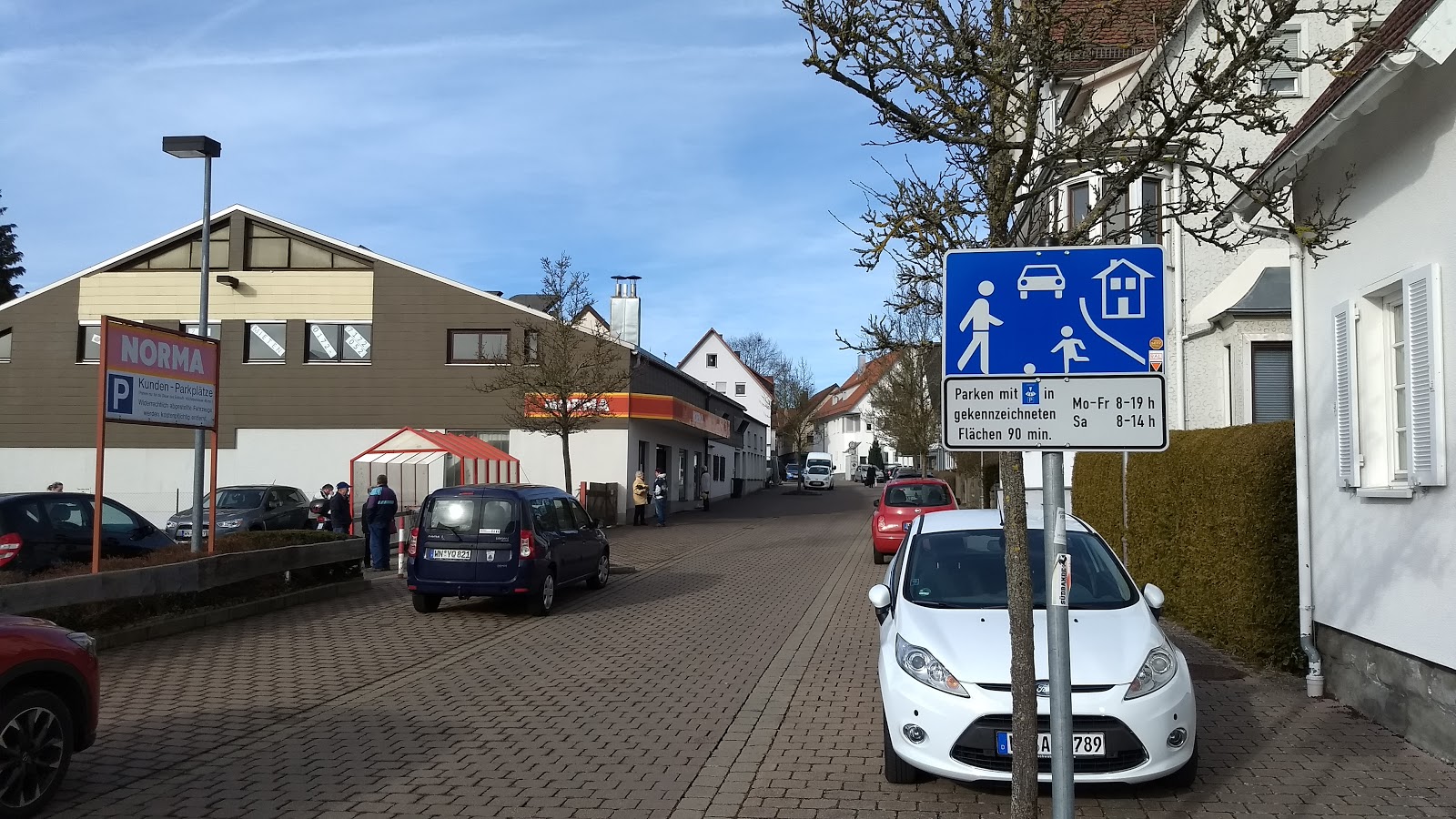


What about commercial streets? Welzheim's main street looks like this:


The speed limit is 20 kph (12 mph), and as a pedestrian you can easily cross the street wherever you like. Through strategic placement of planters or on-street parking spots, there will be locations where two cars can't pass each other, keeping speeds down.


Going one step further, some cities have pedestrian malls in their city centers. This is Schorndorf:


Biking is sometimes restricted in these areas, either banning bikes at specific times or asking people to bike at walking speed. Deliveries by car or truck are permitted only during a short time window each day.

Bike parking is not that great by Madison standards. If there are bike racks at all, they often default to what Germans call the Felgenbieger (rim bender) style of rack. This is probably one reason that kickstands are very common on bikes, allowing people to just park their bike wherever when they go for a quick trip to a shop.

E-assist bike on a rim bender rack
Note the wheel lock on the bike on the right. Good enough for a quick stop.

At train stations and in larger cities, bike parking facilities tend to be better. For instance, at the Bad Cannstatt train station, there is a "bike station" where you can valet your bike (and also have it repaired while its parked there). With the Judge Doyle Square bike center, Madison is poised to get similar facilities. We'll have to see how well they work without a transit location.

The bike station is run by a charitable enterprise, training and employing people with disabilities or other challenges


Once you get out of town, biking can be really awesome. One feature of the region is a dense network of farm or forestry service roads and tracks. For historical reasons, parcel sizes in this part of Germany are very small. This is an aerial image of Welzheim and its surroundings (Image: Google Maps).


All those little strips of fields that you can see are owned by different farmers (and the same is true for forest parcels). And of course that means that each farmer has to be able to get to his or her field. The service roads to get them are public right-of-way, but motor vehicle access is limited to farm traffic. 
Farm road

Forest service roads are usually unpaved
Navigation on these roads and tracks used to be a challenge. There is no orderly grid system, and it could often be hard to tell where any given road would take you. Fortunately, over the past decade or so, communities have made much progress on signing bike routes that string together little pieces of road to connect villages and cities.
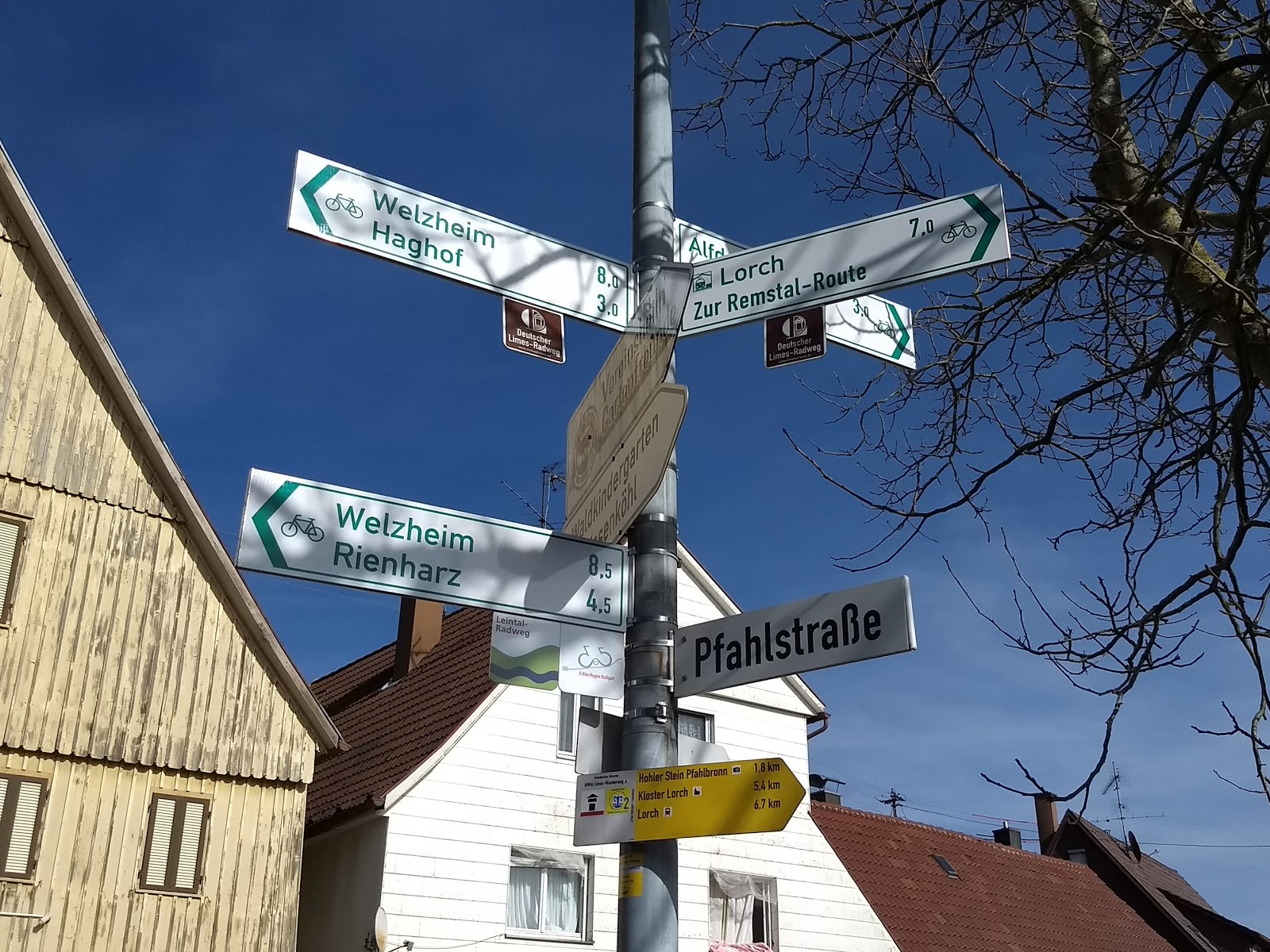
The green signs point show bike bike route destinations and distances; the small square signs underneath them are for touristic bike routes; the yellow sign is for hiking.

I want to be clear that there are some problems with these routes: Welzheim is in a rather hilly area, and the easiest routes up those hills are often taken up by roads. So if you follow a bike route, you should always be prepared for steep climbs. The routes also do not get cleared of snow in the winter. And finally, sometimes the routes are geared more toward recreational biking instead of providing the most direct route. But overall, they provide an amazing low-stress network for people biking, for recreation and transportation alike.

Some snow left on this forest road


Are there any takeaways for bike advocacy in Madison? Obviously some of the things I have described we can't recreate here. The issue of traffic calming may offer some lessons, though. Many advocacy efforts here in the US focus on creating protected bike lanes as a way to enable people of all ages and abilities to bike. And there are good reasons for that. But at the same time we shouldn't lose track of the fact that traffic calming can also create spaces that are great for biking and walking (and have other benefits such as reduced noise). This applies not only to residential streets, but also to commercial corridors. This does require being serious about it, though. Merely slapping a 20 mph speed limit sign on an otherwise unchanged street is not going to be enough. And neither is the occasional speed bump or sporadic enforcement. Diverters that prevent cut-through traffic, reducing the width of a street, creating bump-outs at intersections--these are some measures that may transform a street into one that many people will feel comfortable biking on.

A second takeaway is that good signage can add a lot of value at little cost (financial and political. In a way, the farm roads in Welzheim are similar to, say, the network of multi-use paths in Fitchburg.

Fitchburg path network (Map: OpenStreetMap contributors)

You can get to many destinations on those paths. But unless you're really familiar with the area, navigation is a challenge. Similarly, if you're riding on the Southwest Path or Cap City Trail, knowing where to turn off to get to a destination on Monroe or Willy Street is not obvious. Good signage would help with this. Dane County actually developed a "Bicycle Wayfinding Manual" (warning: big pdf) to address this issue, but implementation has been slow so far.

Monday, August 28, 2017

Lower Yahara River Trail is open!

Just a quick post fueled by excitement: Yesterday was the opening day for the first phase of the Lower Yahara River Trail. This trail connects Madison with the little town of McFarland. Previously all the connections between the two consisted of heavily trafficked roads. This new trail will open up a new route for commuters as well as recreational cyclists. I went out there last night and took some footage of the trail:

Smooth asphalt, great signage, and a long boardwalk across Upper Mud Lake/Lake Waubesa. And a tavern at the McFarland end of the trail. What more could you ask for?! (Okay: There are two more phases for the trail, eventually connecting it all the way to Stoughton. So there is something more to ask for. But for now I'm really happy and excited!)

Saturday, December 15, 2012

Observations from Berlin

Bikes are everywhere in Berlin, even in the famous food department of KaDeWe
Last summer I spent a couple of days in Berlin. I went to university there between 2001 and 2007 but haven't been back for a few years. Before moving to the US I did bike a decent amount, mostly for transportation, but would never have considered myself a "cyclist"--a bike is just what gets you around town faster and cheaper than the subway or bus. In addition to my changed attitude and behavior, cycling in Berlin has changed, too. The modal share has increased quite a bit and infrastructure keeps getting added or replaced. So it was quite interesting to be back and I wanted to share some of my observations.

The bike rentals

Bike rentals are everywhere, and they are dirt cheap. We rented from Lila Bike in Prenzlauer Berg and they charge 8 Euros for the first 24 hours and 5 Euros for every day after. We picked the bikes up on a Sunday and it was completely crazy with people flocking in by the second to rent or return their bikes. In addition to specialized bike rental places one could also rent from bike shops and even convenience stores. The bikes usually are heavy step-through city bikes with internal gear hubs, big, cushy saddles, dynamo-powered lighting (a legal requirement in Germany), fenders, a rack, and wide, puncture-resistant tires. North American cyclist might scoff at these bikes and they are certainly not meant for riding a century, but for riding around Berlin with its many cobblestone streets they work very well.
On one day we used our rental bikes to ride out to Pedalpower in Lichtenberg to rent a tandem. Pedalkraft makes their own tandems and cargo bikes, and for 25 Euros per 24 hours we got a step-through tandem with S&S couplers. Rental opportunities for other kinds of more specialized kinds of bikes exist, too.

Finally, Deutsche Bahn offers Call-A-Bike, a system similar to Bixi or Velib.

The sidewalk cycling and salmoning

Bike traffic can be heavy and unfortunately there is a large amount of sidewalk cycling. It is illegal and there is some enforcement (we saw someone being pulled over while we were on [or in this case: off] the tandem) but a lot of people don't care at all and ride on the sidewalk pretty aggressively. We stayed near Schönhauser Allee and this is both a sidewalk cycling and salmoning hotspot -- partly probably due to the fact that it is a big uncrossable street with the elevated subway in the middle.
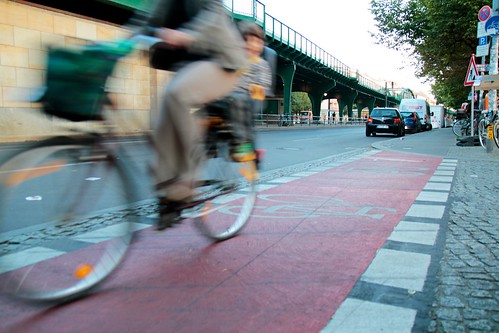
Fahrradweg auf der Schönhauser Allee
Salmoning on the Schönhauser in action (Photo: GBiB; license CC-BY-NC-SA)
In 2008 the modal share for bikes was 13% for the whole of Berlin and I'm sure it has grown since then. As in most cities, the numbers change the farther away from the city center you go, but even the outer borough have a significant amount of cyclists. A high mode share combined with bad behavior and bad infrastructure creates a lot of tension but cycling is still a very safe activity in Berlin.

The bike shops

Perhaps unsurprisingly, there is a huge number of bike shops around town. I was looking for a couple of more or less exotic parts and for that reason visited a number of them. One really nice thing about them is that they can usually order every part that Hartje, the major German wholesaler, has in stock within 24 hours! And you don't even have to pay upfront.
Another great discovery was Cicli Berlinetta. They specialize in vintage Italian racing bikes and their shop is just a-m-azing! In addition to gorgeous frames they also have vintage components and apparel, and they also build their own custom frames and bikes. Even though I'm not the biggest retro-fan I can highly recommend a visit there!
Retro heaven at Cicli Berlinetta

Steel bike pr0n


The bikes

Pretty much any kind of bike imaginable can be found in Berlin. In comparison to North American cities, the proportion of upright city bikes is much higher and what is known as "hybrids" doesn't really exist as a category. The proportion of bikes equipped with dynohubs has increased significantly compared to when I lived in Berlin; sidewall generators, however, are still a common sight, as are ninja riders with no or broken lights.

The infrastructure

turning right truck brakes because of bicyclist
Situations like this are common in Berlin and kill several cyclists every year (Photo: quapan; license: CC-BY)
The types of bike infrastructure has a similar variety to the types of bikes ridden. In terms of quality it is a mixed bag, too. There are horrible cycletracks, probably dating back to the 1980s, which are narrow, have potholes and bumps galore, and put riders at a high risk of right-hooks (the major cause of cyclist deaths in Berlin). In general, the infrastructure built in recent years is not as bad -- mostly on-road cycletracks with somewhat decent solutions for the intersections. When riding by myself I would usually ignore the bad kinds of infrastructure but my significant other did not feel comfortable enough to ride on major roads. What has improved in the past years is signage: several bike routes, either leading to and from the center or on tangents, have been developed and they're well marked.
The legal situation in Germany is somewhat complicated: most basically, cyclists are obliged to use bike infrastructure -- but only if it is marked with certain signs, such as "Z 237". In principle these signs should only be put up in situations where there is an "objective danger" for cyclists but in the past local administrations haven't taken that requirement too seriously. Bike advocates have used the courts to get rid of a lot of the signs and in Berlin I have gotten the impression but the administration has gotten much better about giving cyclists a choice to use bike infrastructure or not.
Z 237: If you see this one you have to use the bike lane/cycle track

The helmets

My significant other had been told by someone at a conference that helmet use had increased significantly in Berlin. I was somewhat skeptical of that, as the statistics for Germany indicate that helmet use after a couple of years of growth is now stagnating or even declining. And that indeed seems to be the case. It's hard to guess accurately but I'd say that only 10 to 20 per cent of cyclists wear helmets.