Thursday, January 26, 2012

Review: Innova 700x35C Studded Tires

Back in November, I published a "first look" article on my newly mounted Innova snow tires. After having ridden them for only a few kilometer they seemed like reasonably nice tires: cheap, not too heavy, not too much rolling resistance. Since then I have ridden the tires for approximately 1500 km and my verdict is very different now. The Innovas turned out to be a bad investment for me.
Before...
...and after

The main reason for this are the steel studs. In the initial review I pointed out that steel studs have a reputation for not lasting long, and now I can say for sure: yes, they really don't. I admittedly rode more than usual this winter and a lot of it was not on snow or ice but just bare pavement. But the degree of wear just isn't acceptable. On the pictures you can see that a lot of studs have completely sunken into the tire. In addition, I have lost two studs in the front tire, despite following the manufacturer's advice to break in the tires by careful asphalt riding for the first 50 km1.

The studs on the rear tire have completely sunken into the tread


The problem is exacerbated by the overall low number of studs. 110 studs make for light weight and low rolling resistance, but on a 622mm tire they limit the performance on ice. I got a taste of that when -- somewhat foolishly -- I endeavored to ride over a bike path covered in snow that had been turned into ice by freezing rain. I quickly realized that this probably was not a very good idea but once you're on the ice there is not much you can do. So I kept going at a very slow pace, but after maybe ten meters it was over. Wham! The front wheel slipped and down I went. I landed on my behind and aside from a painful bruise no physical damage was done. The mental damage, a loss of trust in my tire, however, was quite severe. In my post-accident analysis I've come to the conclusion that 110 studs is not enough for riding on uneven ice on a 622mm tire. A 35-622 tire has a circumference of 2168mm, meaning that the studs are about 40mm apart on each side. On uneven ice that's definitely enough to take you down.

Do I have anything good to say about the tires? Well, they have a nice tread which works well in snow. And as long as the studs were still reasonably new they worked well enough for Montreal conditions. Because of the wear issues I can definitely not recommend this tire; however, if Innova would produce the same tire with carbide studs, like the very similar Suomi Tyres W106, it would make a pretty good commuting tire for urban conditions with infrequent ice. For next season, I will probably switch to something like the Schwalbe Marathon Winter with 294 studs. 

Product details:

Innova TR5263 Snow tire
110 steel studs
700x35C (37-622), also available in 700x45C
Price 40-75 USD

1 This is fairly common, however, even with more expensive tires from Schwalbe or Continental.

Wednesday, December 21, 2011

Measuring the SP PD-8 hub

UPDATE January 2015: You can now find a technical drawing with measurements here.
CORRECTION: Please note that an earlier version of the post claimed that the center-to-flange distance is 32mm. I've corrected that to 22mm. Sorry for the confusion.

I'm getting read to build up new wheels with my recently acquired dynamo hubs. In my previous post, I had posted the manufacturer's stated dimensions, but I realized that they only provided the pitch circle diameter and the flange diameter--the latter being irrelevant for determining spoke length--but not the center-to-flange distance and also not the spoke hole diameter.

The best instructions for measuring a hub come from Roger Musson, author of a popular book on wheelbuilding. Fortunately, he has made this part of the book freely available. All you need to take the relevant measurements are calipers and a ruler. Musson suggests to drill a piece of wood, so that you when you insert the hub's axle the wood will be flush with the locknuts. If you're building a lot of wheels this probably makes sense. As an alternative, you can just measure from the end of the axle and then subtract the easily measurable distance between axle end and locknut. Then use the ruler to measure the distance between the wood/axle end and the inner side of the lower flange (what Musson denotes as x). Then turn around the hub and repeat the measurement on the other side, giving you the y value. With the SP disc hub that's a bit tricky, as the diameters of the two flanges are different. Musson's suggestion is to use a small piece of cardboard, mark it, and then measure on the cardboard. I was in a bit of hurry and thus just eyeballed it with the ruler after seeing that x and y would likely be the same for this hub. X and y are not the actual values needed for calculating spoke length, but they allow you to calculate the desired value by subtraction from half of the over-the-locknut dimension of the hub, z in Musson's system. On modern front hubs for regular bikes you don't really have to measure this, as it is a standardized dimension at 100mm. For the PD-8, x and y equal 28mm (32mm-4mm for the distance from axle end to locknut), yielding a center-to-flange dimension of 22mm on each side.


The flange diameters can directly be measured with calipers. Just make sure to measure from the centers of the spoke holes. The PD-8 comes out to 52mm and 58mm. The spoke hole diameter is a bit tricky to measure: The inside jaws of regular calipers tend to be too big for such small holes. I measured 2.7mm, but as most hubs use 2.5mm holes I'm assuming this is a measurement problem.

Now you can plug your values into the spoke length calculator of your choice and voilá! I recommend Karl Stoerzinger's Freespoke or the DT Swiss calculator.


Wednesday, December 14, 2011

First impressions: SP Hub Generators PD-8 and PV-8 (updated)

Wouter Scholten's website is a great resource for all hub generator lighting issues. He extensively tests almost all models of hubs and lights on the market in real world settings, and he is also unusually well-informed with regard to the introduction of new products. A while ago, he wrote about a new player on the hub generator market, Shutter Precision Ltd. from Taiwan. As the name implies, they started as a supplier for digital cameras and then later moved into bike component manufacturing. While the company itself has little name recognition, they are (presumably) the suppliers for two better known companies, Velo Orange[1] and Supernova.

After having introduced their switchable dynamo (in my opinion a solution in search of a problem), at the 2011 Taipei Cycle Show SP announced what would be the lightest generator hub, the SD-8 (disc brake)/SV-8 (rim brake). These two hubs, however, only are rated to a power output of 2.4W in a 622mm wheel, making them not street-legal according to the German StVZO requirements. However, they also announced a slightly more heavy model rated at 3W, the PD-8 and the PV-8. The technical specs and the prototype tests by Wouter sounded promising, and when Wouter's shop, Gambiet Fietsen, offered them for pre-order in September I went in for two generators, one disc, one rim. The disc one will replace my Shimano DH3-N80 on the Cross-Check which I unfortunately messed up while trying to re-grease the bearings, and the PV-8 will be part of a second front wheel for Gunnar, finally allowing me to turn him into a real brevet bike.

The hubs arrived yesterday, at a total price of 180 Euro shipped. The actual wheelbuilding will have to wait for a little while longer, but I wanted to share some pictures and impressions.
PV-8 in its original packaging. I'm not sure if all the color and spoke count variants are or will be actually available.

The hub looks quite similar to the current SON 28...

...but it does have the same terminal as Shimano hubs

Here you can see the German K-certification wave, making the generator street legal in Germany


The weight pretty much exactly matches the claimed weight.

Both the disc and non-disc version of the hub match their claimed weight of 390 g and 410 g, compared to 440/460 for the new SON 28, 490 g for the Shimano DH3N80, and 399 g for the Supernova Infinity S (center lock disc mounts). Only the SONdelux at 390 g (rim) and 395 g (disc) can match this, but at a significantly higher price point.

SP claims that the new generators do not only excel in weight, but are also "the most efficient" generators (this refers to the 2.4W ones) and their product sheets has a couple of graphs that show the generators to be more efficient than the SONdelux. I'm somewhat skeptical about those claims and am very much looking forward to some independent testing.

Measuring the dimensions of the hubs is a bit tricky with the tools I have and I've only been able to find the manufacturer's numbers for the 2.4W version. Probably they're going to be the same for the 3W, but I'll confirm this with Wouter or measure myself. The bearings are sealed cartridges and I'm not sure if they are user-replaceable.

I think that's all I can say for now. Once I have the wheels built up and ridden them a bit, I will post an update.

Update 2011-12-16:
In the meantime I've found the website of SP's distributor, and their catalog lists the relevant dimensions as follows:
PV-8 PD-8 (non-disc/disc side)
Spoke P.C.D. 52mm  52mm/58mm
Flange diameter 60mm 60mm/66mm

They also have "replacement instructions" on their site that might contain instructions on how to replace the bearings. Unfortunately, the document is corrupted, though, and can't be opened. I've sent them an e-mail and we'll see if I hear back.

[1] If I remember correctly, the Velo Orange switchable dynohub got some bad reviews. At any rate, they no longer seem to sell it.
[2] There is also a 2.4W version, called SD-8/SV-8, suitable for those on small-wheeled bikes or those who don't care about the extra power/street legality in Germany.

Thursday, November 24, 2011

First impressions: Innova 700x35C Studded Tires

Update 2012-26-02: I now have posted an extensive review of the tire.

The first snow of this winter has arrived in Montreal, and it was quite a lot. As an avid follower of various kinds of weather forecast (yesyes, I'm soo boring) I was, however, well prepared. The night before I put on my new studded winter tires. I bought them sometime in spring, knowing that in winter it can often be tricky to still find studded tires in stock. The only tires in a suitable size -- my fenders only allow a max of 38 mm wide tires -- that my bike shop had available were Innova Snow Tires in 37-622. The tires have a pretty aggressive tread and a total of 110 steel studs, positioned in two rows near the tire's center.

The Innova website is pretty uninformative, and I also couldn't find much information elsewhere on the interwebs. I'm curious how the steel studs are going to hold up. More expensive snow tires from Schwalbe, Nokian/Suomi, or Continental use carbide studs which are harder than steel and should therefore last longer and will also not rust -- even though that is primarily a matter of aesthetics. In principle, the studs should be replaceable and I'm assuming that I could use carbide replacements if necessary. Measured width was about 33 mm on an Alex DA-16 (internal rim width 19mm).


Price


I paid 40 USD per tire at my LBS, which is a pretty good price for studded tires in North America. Last week I saw them at a bike shop in Montreal for 75 CAD each and on Amazon they sell for 64 USD (if you can fit 45mm, you can currently get them for 36 USD there). So they're not cheap when compared to normal tires, but in the world of studded tires they're probably the cheapest you can get. And if they prevent only one crash they're probably already worth it.

Ride quality


 I took the tires on a first 80 minute test ride on the night before the snow actually arrived. It is advisable to break in studded tires, i.e. riding them without hard cornering or braking, for a couple of kilometers in order to allow the studs to set themselves in the tire and avoid losing them prematurely. So I rode along the Lachine Canal bike path, which was mostly dry with some icy puddles. On dry pavement, you can clearly feel the increased rolling resistance of the tires. Up to now I have been on Vittoria Randonneur Pros in 35-622, which roll very nicely, and thus the difference was very noticeable. The best way to describe the feeling of the tires is "riding into a slight headwind." What is even more noticeable than the rolling resistance is the noise of the tires: people often joke that you can take off your bell when you're riding studded tires, and I have to agree: the sound is very similar to riding on fine gravel, even though I think the tires have gotten a bit quieter on the third day. There were some frozen puddles on the Lachine Canal path, and I somewhat cautiously tested riding over them. All went well and so I got a bit bolder: Braking on the ice also worked pretty well.

The next morning I rode into work once the snowfall had mostly stopped. I tried going my usual route on the Lachine Canal, but they don't clear the snow there at all and riding through deep snow wasn't too awesome, even with the new tires. At the next intersection I therefore turned onto the streets which were more or less snow-free. On the more snowy parts, the tires performed reasonably well -- I would say better than the Ritchey Cross-Pros I had been riding during the past winter, but it's hard to tell. On the way back, the roads were mostly snow free, but I did go across an icy pedestrian bridge near Atwater Market. Here the studded tires were great, and I think not having to worry about icy patches that can often be hard to spot is the main advantage of studded tires.

Since then it had gotten warm again and I have taken the tires off. The next snow and ice will come soon, though, and I will probably post an update at some point.


Product details:


Innova TR5263 Snow tire
110 steel studs
700x35C (37-622), also available in 700x45C
Price 40-75 USD

Monday, November 21, 2011

Ride report: 150 cold kilometers

It's time for the annual winter trophy again, and this year I'm member of a pretty hardcore team. My last two weekends were spent with conference and work travel and I had fallen behind quite a bit. The weather forecast for Saturday looked okay -- about 5 degrees and dry -- and so I decided to do what could be the last really long ride of the season. I combined a bit of a previous route with some new bits, resulting in a 150km course that would be almost exclusively on bike paths and lanes.

I made up my mind of where to go last minute, as per usual, and only got on the road around 11:30. The only crossing of the St. Lawrence that hasn't been closed for the winter yet is the Jacques-Cartier Bridge. The offramp of the bridge is only a few blocks away from the Route Verte 1, which led me out of Longueil first on bike lanes/cycle tracks and then on bike paths more or less away from traffic. There was a steady headwind coming from the south which kept my speed at around 20 km. Once I reached Chambly I made my first stop of the day on the beautiful shore of Lake Chambly. One of the things that suck when biking in the winter is that you can't really have any longer outside stops, and thus only ate a Clif Bar (as an aside: their new coconut-something flavor is great!). I had done this part of the ride before on the 100k-ride with the Biketopus, but now I crossed the Richelieu river instead of continuing along the Chambly Canal.

On the OpenCycleMap I had found the Route des Champs which leads east toward Granby. The description on their website promised a mostly paved, partly gravel route and so I was quite shocked when I got to what I thought was the trailhead outside of Chambly: the trail was basically an old railway bed with the tracks removed. I tried riding on it for maybe 50m, but it was almost impossible to ride on the loose rocks. At the next intersection I stopped and considered my alternatives. Only then did I spot the actual trail only 30 meters to the north, parallel to the busy highway. Phew.

The Route de Champs was very nice to ride on: very long straight stretches, few intersections, and a nice hardpacked gravel surface. The Route des Champs meets the Route Verte 1 in Granby, but that would've been too far and thus I turned south in Saint-Cesaire, now following the Yamaska River on a very quiet country road with surprisingly good pavement.

In Farnham I then turned west again on the Route Verte/Monteregiade and took another Clif Bar stop, which was highly overdue -- I could already feel some bonking symptoms. The Monteregiade, built on the right-of-way of a former CN railroad, is lovely to bike on and for the first time on the ride I had a bit of a tailwind. After less than an hour I arrived in St. Jean-sur-Richelieu and took another rest stop at the gas station (note to self: never again buy grape-flavored Gatorade). I was a bit disheartened to see a Route Verte sign saying "Montreal 60 km," but once I got going I felt pretty good again.

It was pitch black at this point, but with my trusty B&M Cyo lights riding the gravel trail along the Chambly Canal was very pleasant. The ride back to Montreal was not very eventful and after almost exactly 150 km and 7 h 25 minutes I arrived back home. The 29 Winterpokal points (at least temporarily) catapulted me on the third place in our team.

Thursday, May 26, 2011

A Converge Show, a Night Ride and a Skunk

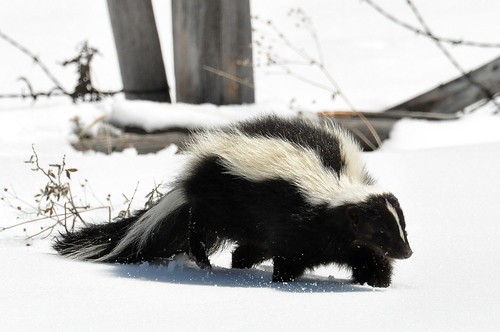
Striped Skunk (Mephitis mephitis)  DSC_0030
Mephitis mephitis by Dan Dzurisin, CC-By 2.0
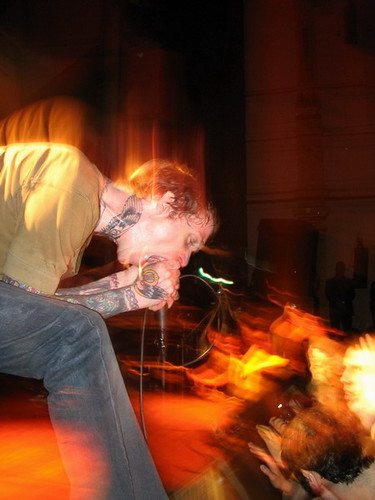
A couple weeks ago I heard that Converge were going to play at the Lost Horizon in Syracuse and, Converge being one my absolute favorite bands, I wanted to go!

Only how to get there? Bus service to Syracuse is basically non-existent and taking the carshare car would have been too expensive. That left me with either getting a rental car or taking the bike. It's about 90 km to Syracuse, i.e. easily manageable for a one-way ride, but pretty far for a return trip. Initially I planned on riding there, staying overnight in a cheap motel and then riding back the next morning, but riding back the same night seemed like an interesting and challenging option.

I left Ithaca around 2 p.m. on Wolfgang, loaded with only a Frontroller. A large part of the route I had done previously on my Winter Adventures ride. Between Freeville and Munsons Corners I had a flat due to a not properly vulcanized tube patch. Because I only had brought one spare tire and didn't like the idea of potentially having to patch a tube on the night portion of my ride, I decided to stop at a bike shop in Cortland. Thanks to my smartphone and an open wifi access point I found my way to Action Sports on N Main St -- only to realize they were closed on Tuesdays! Oh well.

After that little detour I continued north on NY-281, with traffic gradually getting lighter. After a short break in Tully, I turned east on NY-80 and then turned left again onto Apulia Rd, leading me north towards Syracuse. Apulia Road is lovely: following a river and the railway, it is slightly downhill most of the time, pavement is great and traffic is very low. At Jamesville Beach County Park I made a stop to refill my water bottles (their restrooms were locked, unfortunately) and continued towards the huge quarries just outside of Syracuse. After going through an underpass across I-481 I then rode through nice residential neighborhoods on low-traffic streets and finally arrived at the Lost Horizon a bit past 7 p.m.

Unfortunately, there was no proper bike parking anywhere near the club and thus I hid Wolfgang behind hedge. The Converge show was really awesome and made me forget my slightly sore body. Therefore I decided to indeed skip the motel and ride back right after the show ended.


Converge
Converge by Francis Bijl, CC-By 2.0

I left around 10:30 p.m. and returned on the same way. Riding at night can be really nice: almost no cars, no noise except for the sounds of wildlife, and also no wind. The sky was mostly cloudy and the moon did not rise before 2 a.m. To prevent tiredness and boredom I listened to podcasts on my phone for quite some time but eventually ran out of them. Then somewhere between Tully and Cortland it happened. I wasn't properly paying attention to the road and suddenly I hit something. I didn't crash but it was quite a bump and a gross, cracking sound. I must have run over an animal, presumably an already dead one. I had little desire to go back and take a closer look and just continued on my way home. Only when I arrived in Ithaca at 4 a.m. and carried the bike up the stairs to our apartment I realized something was wrong: during the ride I had smelled skunk every once in a while but didn't think much about it -- it's a fairly common thing in rural Upstate NY. But not in our building! So it dawned on me that the run-over animal must have been a skunk. A smell test on Wolfgang's tire confirmed by suspicion and I decided to park outside...

Stats: 190 km, about 1400 m of climbing, average speed of 21 km/h

Friday, April 15, 2011

What keeps a bike upright?

It's rare that bicycles feature in the Cornell Chronicle, but today there is an article about interesting research by Cornell prof Andy Ruina on what prevents bikes from falling over. The main finding is that conventional theories of self-stability -- the gyroscopic effect of the spinning wheels and trail of the front wheel -- are not the main factors in keeping a bike stable. Ruina and his collaborators have constructed a bike (well, it doesn't look exactly like a bike) that has no gyroscopic effect and no trail -- but still stays upright on its own. Fascinating stuff with potential practical implications for bicycle design.

There's also a video explaining the research, and here's a the pre-print of the article which will be published in Science.